Showing posts with label God in my life. Show all posts

God's Grace Flourishes in Our Vulnerability


As any mom—and I’d even wager any babysitter—knows, taking care of a baby isn’t for the faint of heart. It is rough and tough business that hit me like a ton of bricks when I had my first baby. I had no idea a person as small as she could sleep so little and still manage to cry as much as she did. At times, I even joined in with my daughter in her crying spells when nothing else was working.

Those early weeks were nothing less than brutal, leaving me weak, weary and brittle, on edge of breaking.

When my daughter was two-months-old, our church threw a baby shower for the latest round of new or soon-to-be-expecting moms in the congregation. I was among them and toward the end of the luncheon, each of us were supposed to share how our journey was going, whether it was pregnancy or parenthood, and some prayer requests.

Early on, I’d committed myself to try not to complain about my daughter. I wanted to be honest about how hard things were going but I didn’t want to whine about it or make her out to be a foe. So when it came to my turn, I started off positively enough and asked for prayer for me to submit myself to this process of parenthood and learning self-sacrifice, which is what I felt the Lord was urging from me at the time.

And as I asked for that simple prayer, I couldn’t help it but the tears came. They came, they poured. Even though I’d spent plenty of time crying on my own at home, I hadn’t cried in public before. So when the chance came, the tears flowed and I couldn’t stop them until I shared the truth.

With them streaming down my cheeks, I couldn’t deny how very hard things were as a new mom. Raw with honesty, I shared through those tears how hard it was being a new mom. And through those tears, I began to see God work.

When I was done, other moms in the room came up to me, tears in their own eyes and told me they knew exactly how I felt. Other women who were pregnant with their first told me that they appreciated my honesty because it provided them a much-needed reality check that things might not be all as the commercials portray with a newborn.

But the biggest blessing that came from those tears became evident when I went home. Because once I admitted my hardship in the midst of so many other women and asked, so sincerely, so desperately for prayers, things actually started getting better: My daughter started to fight her sleep less, even going to sleep on her own. She began crying less. It was nothing short of a miracle.

It’s something I’ve seen over and over again in my life: God’s grace flourishes in our vulnerability. When I’m willing to let my guard down and admit my weakness, admit my need, admit my struggles before my fellow man, it is then that I oftentimes see God at work the most. Like James 5:16 says, I think there’s power in confession, whether it’s confessing your sins like that verse says or even confessing the truth about our circumstances and our needs, like I did that afternoon in the chapel of our church when I let the tears fall before a couple dozen women.

"I tell you the truth, unless a kernel of wheat falls to the ground and dies, it remains only a single seed. But if it dies, it produces many seeds." John 12:24

This article first appeared on iBelieve on July 26, 2013.

Related Posts
My True Story of Being Healed by Prayer
Deserted Islands and Sanctification in Marriage ...
READ FULL POST >>

I Am Brave (And So Are You)


I don’t often think of myself as a brave person: I prefer to go places and try new things with someone else (namely, my husband). I don’t love change. I don’t even like swimming. I’m happiest getting to sit at home with my loved ones or take a walk out in nature on a lovely day.

But when I was doing my Bible reading the other day, I came across a verse that turned all this on its head. Bravery doesn’t have to mean you swim with the sharks or take off with just the clothes on your back to travel to a far-off land.

No. Bravery is more than that:

“We live by what we believe, not by what we can see. So I say that we have courage.” 2 Corinthians 5:7-8

I’ve heard people quote that verse before, but I’ve never let it sink in, settle into my soul and whisper to it: You are so brave. You are weak, but you are so strong. Strong and brave and everything else I’d never use to describe myself all because of the simple fact that I believe. Because all those other things that we think describe bravery are just actions. But belief, faith, is on the one had so much more than that and yet so much simpler.
It is beautiful in its simplicity. And comforting to this heart of mine that doesn’t often feel very brave.

Yet, I am. Because my belief has taken me incredible places, given me the courage to make incredible choices, made what could have been an ordinary life into something truly, really incredible.

And, yet, though I knew at the time those were all leaps of faith—I wasn’t always quite sure how they would work out, where they would lead to and what would come next—I never felt like I was gambling or putting my future at risk. Because my heart was rooted in that one thing: Belief. And when that is what is the guiding force, it never fails. I never have to worry.

I simply have to be brave and believe.

Related Posts
A Season of Struggles and a Prayer for Reprieve
The Truth About My Inadequacies: A Lesson from the Bible
READ FULL POST >>

The Story of How I Decided to Leave Everything I Knew and Move in Pursuit of God (Part 3)


I'm currently in the midst of relocating from Georgia to Ohio, so I thought it was a fitting time to look back at another time in my life where God moved me across the country: I was 24 and single, and moved from my hometown in Ohio to Grand Rapids, Michigan, where I knew one person in the entire state.

Earlier this week, I shared the first part and second part of my story about this leap of faith. If you missed it, click here to read Part 1. And click here to read Part 2. Today I am sharing the last and final bit, Part 3, in my story about how this all unfolded. 

Back in Ohio, I received word that I was invited back for a second interview. I ended up having to reschedule because the original date they wanted me to arrive fell during the week I had already arranged to chaperone a youth group trip. (As it turns out, this was the youth group trip where I got to know the man who would someday become my husband!) Fortunately they were flexible and were able to push the interview back another week.

I remained calm and at peace with the situation—until the night before the interview. At that point I had what I’d probably compare to an anxiety attack although I have nothing to compare it to. My heart was racing, I was short of breath, I was hungry, I was thirsty… I tried to pray through it but nothing worked. I barely slept and the next morning, I was still anxious the whole drive up. Even when I went into the interview, the anxiety was still right there, punching me in the face.

Looking back, I really feel like it was the devil’s one last-ditch effort to psych me out and pull me away from God’s plan. Because at one point, I really just wanted to call them and tell them to cancel the interview. And what was I afraid of? Of getting the job? How ridiculous is that?

It wasn’t until about halfway through the interview that I regained composure and the anxiety left me. By that point, the anxiety had already made me mess up a bit more than I normally would have so I figured that if I was able to get the job even after that–admittedly, not my greatest interview–then I knew God was in on it. I walked out of the interview at peace with whatever would happen.

The next Monday, I received an email offering me the position. Just. Like. That. I couldn’t believe it, that it all had really, actually happened. That God had planted this desire in my heart and arranged everything to come together and then he actually gave it to me.

As I considered all of that, I knew that I had to accept the job, even though by this point my friend had realized she didn’t want to move to Grand Rapids and I’d be doing it alone. Sure, there was uncertainty but I had seen so much of God’s goodness already, how I could expect any less of it in the future? God truly was so powerful in the knitting together of the situation, that I could not deny it. I could not turn away from it, from him.

I wanted this to be one of those times where I heeded and obeyed God, in hopes that doing so would make it easier for me to continue to heed and obey him in the future. Because I didn’t want to look back and say the only time I really knew I was listening to God and God was with me was when I was 24. I didn’t want to turn it down out of fear and run the chance of deadening my heart to listening to him in the future, as well. That would be so disappointing and heartbreaking.

So, with that awareness, I accepted the job.

Looking back over that situation, it is so encouraging to me to see how God guided the whole process, especially given that I was just starting to flourish in my faith. It was one of the first times that I tried to start to listen to him. And he met me in those places! There were many places along the way where I could have doubted more, where I could have ignored God’s still small voice. But I didn’t because he heaped grace upon grace, peace upon peace all around me.

What another testimony of his lavish love for even the least of these.

(If you want to read more about how God continued to provide for me once I did move to Michigan, you can read more about that here. And, a perennial favorite is my series about how my husband and I met and fell in love, Our Love Story.)

Related Posts
Hope For the "In-Between" Times of Life
Asking for My Daily Bread: God's Provision
READ FULL POST >>

The Story of How I Decided to Leave Everything I Knew and Move in Pursuit of God (Part 2)


I'm currently in the midst of relocating from Georgia to Ohio, so I thought it was a fitting time to look back at another time in my life where God moved me across the country: I was 24 and single, and moved from my hometown in Ohio to Grand Rapids, Michigan, where I knew one person in the entire state.

A couple days ago, I shared the first part of my story about this leap of faith I took. If you missed it, click here to read Part 1.
Time was ticking as we got closer to visiting Grand Rapids and I still hadn’t nailed down any job interviews. I emailed a contact I’d made at the smaller publishing house to follow-up about setting up an interview and she suggested some new job postings for me to consider. None of them were in what I originally wanted to pursue (that of an acquisitions editor—the people who are finding the books to publish) but there were some in the publicity and marketing departments.

I pulled together my application and sent it off. Days later, I got an email that I had an interview with the publicity department while I was in town.

Now I had done this sort of informational interview seeking once before, right after I graduated college and thought I wanted to move to New York City. I couldn’t find a job and decided to visit the city and see what I could do. Before going, I lined up as many interviews as I could, at places like Teen People, Cosmogirl, and YM. (Now it seems kind of silly, but at the time I really wanted to work for a teen magazine.)

So my inclination with this Grand Rapids visit was originally to line up as many interviews as possible, but at this point I only had one. But Something told me to pursue this one avenue—to see it through and to trust. So I fought my urge to blanket the city with resumes and pitches and cover letters. I sat still. And waited.

When we visited in June, it was incredible how people reached out to us. Even before the visit, we seemed to be getting signs that there was a community already waiting for us up there, with people eager to open their homes to us and encouraging us to come.

The one, solitary person I knew in the town let us stay with him and his wife and invited friends over so that we could start to meet people. More people kept recommending folks for us to meet. It was amazing to see that all weave together and the semblance of a community start to take shape for us.

The last day we were in town (a Monday) was the day of the interview. Somehow through the whole process, God gave me an insane peace about everything. And you should know, by nature, I’m a worrywort (as we've already established).

But with Grand Rapids, I wasn’t worried or rushed or stressed or anxious. I just trusted: that God would provide a job if he was going to point me in that direction. That I’d figure everything out with my living situation in Ohio. When people asked me if I’d considered this and what I was going to do about that, all I could do is shrug and say I don’t know yet, and be done with it. How glorious and releasing is that?!

So upon going in for my interview, I could not have been more at ease. I walked in and met with the interviewer, and it was like meeting with a friend. We got along great and talked shop but also talked about life and the way God works. She recommended books to read to me and gave me one to take with me and I made recommendations for her. I walked away feeling like this is a woman I could really look up to and respect, not just as far as a job goes but also as far as having as a sort of mentor in my life. To have that as a boss? That’s pretty phenomenal!

So I walked away from the interview with a good feeling brewing in my stomach–as if I already belonged to this place. My friend picked me up and we went to a cute French cafe and met more new friends before hitting the road for the 6-hour return trip to Cincinnati.

Later this week, I will share Part 3, the final post, in my story about how this all unfolded and what God was doing behind-the-scenes as he prepared to move me to this new town which I could tell was starting to feel more and more like home...

Related Posts
God, Brussel Sprouts & Getting the Job
Turning Down the Job: And Lessons I Learned About Marriage
READ FULL POST >>

The Story of How I Decided to Leave Everything I Knew and Move in Pursuit of God (Part 1)


I'm currently in the midst of relocating from Georgia to Ohio, so I thought it was a fitting time to look back at another time in my life where God moved me across the country: I was 24 and single, and moved from my hometown in Ohio to Grand Rapids, Michigan, where I knew one person in the entire state. It was undoubtedly a leap of faith for me and one that has guided me (and grown my faith) ever since. Here's a look back at how that all came to be:

In March of 2008, I was at work, doing a job I enjoyed where I worked as an editor for a graphic design magazine. I was taking a break from the daily grind and flipping through some articles online–not about design but about faith and the like.

A light bulb went off in my head that if my job had to do with God, I’d be so great about it because that’s where my passion for learning lies. I enjoy design and appreciate design but I don’t seek it out in the way I do information about God.

Now nothing with this light bulb moment would have really gone anywhere had it not been for the fact that I’d recently become friends with a girl at church who was another volunteer with the youth group girls. She confided that she was trying to figure out where she was headed in life and told me about the two places she was considering: Philadelphia and Grand Rapids, Michigan.

After that conversation, I got inspired and went home and started looking up where some Christian publishing companies were. Lo and behold, there were a handful of publishing houses in that little northern town of Grand Rapids. In fact, it’s deemed the Christian publishing capital of the country.

So the more she and I talked about it, the more right it felt to pursue Grand Rapids and this dream of Christian publishing. We set up a weekend to go visit, but one thing led to another and it kept getting derailed. We weren’t able to visit until a couple of months later, in the middle of June.

Trying to maximize this dream of mine, I put feelers out at a couple of the Christian publishers I’d discovered to see if I could meet with any when I was in town. The original publishing house that I thought I wanted to pursue never called me back.

However, there was this smaller one that I contacted and even when the operator patched me through to someone completely unrelated–everyone was so kind and so helpful to me. To me, that was God opening a door, and I took it by faith.

It was a couple weeks before we headed up to Grand Rapids and I still hadn’t secured any job interviews. But I still believed this is what God wanted. I got together with the youth pastor at our church, who had become a good friend, to get his guidance on the situation.

We talked through the reasons why I wanted to move. He had me create a pros-and-cons list of why I wanted to move to Grand Rapids. (He used a neat illustration to explain his understanding of determining what God's will is for our lives. Read more about that here.)

He asked me what I would do if I didn’t get a job up there, would I just move ahead? I told him that I wouldn’t move until I had a job because I felt like that was the whole purpose God was pointing me up there for in the first place, so I trusted that he would provide that.

Somehow God gave me such peace and clarity through the whole process–I’m still baffled.

After our meeting he told me that he wished he could tell me that I was doing it for the wrong reasons but he couldn’t.

I'll be back in a couple of days to continue with Part 2 and sharing my story about how this all unfolded and what God was doing behind-the-scenes.

Related Posts 
Decision-Making: Out of Fear or Faith?
Learning to embrace where God was calling me ...
READ FULL POST >>

Adam and Eve, and a God Who Orchestrates It All


I recently shared about a book I've been reading through and loving: Jesus: A Theography. I was just reading a section that made me stop my reading and sit, once again, in awe of what God has done in my life, particularly in regards to my marriage, and the fact that it's the thing he's been doing all along, ever since the first man and woman in bringing them together.

(I chronicled the whole story about how God brought me and my husband together in a series called, "Our Love Story," which you can read through here, if you missed it.)

The authors are talking about the Genesis 2 creation story, where God has made Adam from the dirt and, upon seeing that he is alone, makes all the animals (from more dirt) to give his creation a suitable companion or helper. But none are found. So, he puts Adam to sleep and fashions woman from Adam's rib.

The authors illuminate what happens next in the story: "Once the woman was split apart from him, God 'brought her to the man,' an image that foreshadows the bridal attendant taking the bride to the bridegroom.

When I read that sentence, the word that popped out to me the most was the word "God." It was God who took the woman to the man. They weren't left wandering around the garden only to bump into one another and then fall in love. No, God orchestrated the entire thing, from start to finish, even to bringing them together and introducing them.

That is what I have seen God to do for me in my own life, and it has made for an incredible journey that still takes my breath away to remember all the crazy facets of it.

But it also made me think of all you others out there who are waiting to be that companion, who are waiting to have this story be your own story. I think of you because I remember that season of waiting, too.

And so I pray the wisdom of this Scripture over you: That it would be God who brings you to your mate and that, just as Adam waited on God to bring along his perfect companion, you too would be encouraged in your waiting.

(And, if you need encouragement while you wait, consider signing up for the monthly Women Praying Boldly newsletter that I send out to a group of one hundred or so women who are committed to praying for one another as they all await God to work this very same way in their lives!)

Plus, you can read more about this book in my review, or you can find Jesus: A Theography on Amazon.

Related Posts
Our Love Story: Becoming Husband and Wife
Marriage: That Which Sanctifies Us
READ FULL POST >>

Overcoming the Fear of Miscarriage: Learning to Trust God with My Own Emotions


Remember that fear I mentioned awhile ago? That fear about miscarriage and the fact that it's still technically a possibility. A possibility that looms before me like a thorny branch in a meadow wild with gorgeous flowers.

Well, I long ago learned that that's the thing with fears: They thrive in ignorance. Soon what was once a verdant landscape can become overrun by the weeds if we let them. That's what fear can do to us, too.

Instead, to really deal with the fears, I must pick up my spade, dig them up and then, show them off for what they really are. Because usually they end up being something without substance, without real roots or depth but those thorns can grow and grow and tangle up everything around them if we let them.

So, I took that fear of mine and I laid it bare before a group of ladies in my community. The dirt and grime still fresh on my hands, I told them that there's a part of me that is afraid of losing the baby.

The thing is, it's not that I don't trust God to give life or to take it away. Perhaps that's how it may appear from the outside, but that isn't it. I learned long ago that I trust God to be in control of my life much more than I trust myself, so if he deems it this way or that, I truly know it is always decided from a place of love for me and whatever God has in store for next. Honestly, I do not doubt that truth.

As I laid this fear bare, though, I saw it for what it really was: It stems not from being able to trust God in that situation but from not being able to trust myself, namely my own emotions. If it were to happen, would I descend into depression and crumble in the face of that sadness? Would I be overcome by those feelings of loss and self-pity? Do I have the strength to keep on loving and leaning and looking forward rather than backward? How would I respond when people ask how the baby is doing, after the fact? Frankly, my own emotions scare me and I have no idea how I'd respond to that kind of loss.

That distinction—about what lay at the root of my fear—was an epiphany, and through it, I felt God telling me that I need to learn to trust even my own emotions over to him. It wasn't a truth I'd really grappled with before. Sure, I know I have to trust my future and my loved ones and my health and my career over to Him and His goodness, but even my own emotions? Yes.

If the unthinkable does happen, I have to be able to trust Him to guide my emotions even as he guides my feet and my fate. I have to trust that He'll step in and shepherd my own heart, because I don't think that's something I can handle on my own at all.

But the beautiful thing that he revealed to me is that I don't have to. I can trust Him with it all, even my own emotions. What peace prevailed from that realization. No matter what happens, he can be trusted. With it all.

Don't worry about anything instead pray about everything. Tell God what you need, and thank him for all he has done. Then you will experience God’s peace, which exceeds anything we can understand. His peace will guard your hearts and minds as you live in Christ Jesus. - Philippians 4:6-7

Related Posts
Decision Making: Out of Faith or Fear?
Jo-Ann's Testimony: Finding Healing from Fears
READ FULL POST >>

“This Little Light of Mine, I’m Gonna Let it Shine…”


"This little light of mine, I’m gonna let it shine…"

I am thinking of this Sunday School sing-along song right now, as I read back through some of the comments on the post about our answered prayers for getting rid of the mice that were in our house from last winter.

Comments like: “I love this story! Such a great reminder that God cares about every detail of our lives!” And, “I love how big and how small God is; big enough to speak our universe into being and small enough to fill a single heart. I always thought felt silly praying for ‘little’ things, but I'm not starting to realize that praying about those little things gives us faith for the ‘mountains.’”

As I ponder those comments, it just so happens that my Bible beside me is open to Psalm 22, which I’d flipped open to look something up for a Sunday School lesson I’m teaching. It’s the Psalm that Jesus quotes on the cross, “My God, my God! Why have you forsaken me?”

Here, David is begging God to rescue him from his enemies. In verse 22 of the Psalm, he writes, “Then I will declare the wonder of your name to my brothers and sisters. I will praise you among all your people.”

There were times when I struggled with this verse because of one little word: “then.” I thought it was like a bargaining chip. “Okay, God, if you rescue me, then I’ll praise you.”

But as I read this in light of that post and those comments, I realize that I don’t believe that’s the case.

Instead, it seems like it's just a mere fact: Like saying, God, when you are active in my life, I will tell everyone about it! It will be an outpouring from my lips that I cannot contain! I will share my testimony of your love and grace and mercy in my life with everyone around me.

And I feel like that is one of the beautiful opportunities that this blog of mine provides: a place to do that, to “declare the wonder of your name to my brothers and sisters.”

And not just the big things—like getting healed of a skin disease. But also the little things—like an answered prayer about having mice leave our house. Sometimes people can scoff at those little things, chalk them up to coincidence or roll their eyes at the fact that I would pray about a silly little mouse when I can just hire an exterminator.

Honestly, those are the excuses I have to fight when I post some of these testimonies.

But in those moments, I am like David, who cannot help but point to my God say, “Look! Look what he has done for me! Look at that love, at that mercy, even over a silly little mouse!” There is that yearning within me to share these testimonies about all that the Lord hath done in my life through this little blog of mine.

And that’s where I go back to that Sunday School singalong song: “This little light of mine…”

In its original context in Matthew 5, Jesus gives the Beatitudes and then launches into teaching about salt and light, saying: “You are the light of the world—like a city on a mountain, glowing in the night for all to see. Don’t hide your light under a basket! Instead, put it on a stand and let it shine for all. In the same way, let your good deeds shine out for all to see, so that everyone will praise your heavenly Father.”

So it is really talking about how our actions and behavior will be “lights” for the faith that is alive in our hearts. As James says, “’I can’t see your faith if you don’t have good deeds, but I will show you my faith through my good deeds.’”

Yet, as I think about this passage in, ahem, light of the mice and my answered prayer and the appreciative comments on that post, it got me thinking about light from another aspect: How our testimonies of what God has done in our lives give light to God’s glory, and how we must not hide them under a basket. As the Matthew passage says, “Instead, put it on a stand and let it shine for all.”

This blog, humble as it may be, is a stand for me, a place for me to put those testimonies up on display and shout out, “Look! Look what God has done!”

Related Posts
My Testimony: Learning About God's Loyalty Firsthand 
Testimony: A Series About God at Work In Your Life 
READ FULL POST >>

Listening to that Still, Small Voice


Following God can be confusing.

Because sometimes, he tells us in big, bold, you-can’t-miss messages what it is he’s doing and how he wants us to follow him or where he wants us to go next. Sometimes it’s just incredibly, refreshingly, undoubtedly obvious.

But then there are those times when you pray and you pray and you just don’t know what he wants you to do next or whether he’s speaking to you. When you try everything you can think of to hear what he’s saying to you, and the line just continues to crackle with silence.

There are times in my life when I’ve been absolutely certain about what God was telling me to do. When Scripture lined up with my heart’s desire, when I was overwhelmed by an only-from-God sense of peace about a decision, when words of confirmation came raining down on me in every direction.

Yet, those times, when it almost seems like God had a bullhorn he was using to keep my attention, are exceedingly rare, especially the longer and further I go in my faith.

In the Old Testament we’re introduced to the idea that God exists not in the wind or the earthquake or the fire but instead in a quiet whisper—what has been translated in other places as “the still, small voice.”

There’s a comfort in this, that even when God isn’t banging on a drum or blasting a trumpet in our ear, he’s still reaching out and leading and guiding us. He’s still speaking to us and beckoning us, it’s just with a more subtle approach. Sometimes, he’s just waiting for us to stop, listen and—this can almost be the hardest part—trust that still, small voice.

Because with such a still, small voice, sometimes it isn’t clear or obvious that what we’re hearing or thinking is from God. What if it’s from me? Even worse, what if it’s from Satan?!

Fortunately, though, Jesus tells us that “My sheep listen to my voice; I know them, and they follow me. I give them eternal life, and they will never perish. No one can snatch them away from me, for my Father has given them to me, and he is more powerful than anyone else.” (John 10:27-29)

Through much of Scripture, we see this assurance that, like the psalter wrote, “You guide me with your counsel, leading me to a glorious destiny.” (Psalm 73:24)

Sometimes we just have to trust that if we are following God and obeying him and loving him and reaping the fruits of the Spirit, that he is guiding us and speaking to us—even when all we’re getting is the faintest whisper and an inkling of what to do next.

For me, it’s a matter of taking the Lord at his Word—literally, trusting that these things he’s said in Scripture are true—and then taking the step to be “faithful with little,” like we see in the parable of the talents (Luke 19).

What I mean by that is that when some vague idea to serve Him or to follow Him or to reach out and show love to another comes to mind—assuming it is not violating Scripture or the fruits of the Spirit—then I choose to trust that it is from the Lord and take a step in faith to pursue it.

For instance, an aquaintance of mine was recently walking through a heartbreaking time. We’re not super close and I’ve never experienced what she’s going through. I don’t have the words to say, and since I’m not really that close to her anyway, what good would it do to say anything anyway?

And yet, as I was praying over her situation, I felt like I ought to send her a card and, instead of trying to say something that made sense of the situation, to just tell her how much she meant to me and how much I appreciated the friendship she has shown me.

I don’t know if it helped, if it encouraged or if she just tossed it out without caring much about it.

But for me, that’s not really the point.

The point is that I choose to credit the idea to the Lord and to take it as an opportunity to, in one tiny way, follow and obey him. Because, as he said while he was here on earth, “All who love me will do what I say. My Father will love them, and we will come and make our home with each of them. Anyone who doesn’t love me will not obey me.” (John 14:23-24)

So in that instance—and many others—where I have a vague notion of serving Him in some—often seemingly random—way but I’m not certain whether it’s truly from the Holy Spirit, I make the choice to trust that it is.

And so I wrote and mailed it—my attempt to be “faithful with little”—and trust the rest to Him.


Related Posts
Being Willing to Serve
When We Try to Make God Choose (A) or (B)
Discerning God's Will for Your Life: Some basic principles to guide you
READ FULL POST >>

Evangelism Need Not Be Apologetics: Some Thoughts About Sharing Your Faith


e•van•ge•lism, noun: the preaching or promulgation (proclaiming) of the gospel
a•pol•o•get•ics, noun: the branch of theology concerned with the defense or proof of Christianity.

Even in the dictionary, these two words, "evangelism" and "apologetics," are different, are not the same thing.

And yet, I think that as Christians, we tend to melt the two together to be one, thinking that if we are going to “evangelize” then that means we have to have all of the answers about why God allows suffering and what going to hell means and how old the Earth is and whether King David really lived or why God does this or says that or what this or that really means.

Having all the answers to those kinds of questions falls into the "apologetics" category.  They're good questions and ones that many of us wrestle with, to be sure. But do we have to have the answers to them?

Too often, I think that we assume that if we're going to "proclaim the gospel" (meaning, "evangelize"), then we must. We think that to share the gospel, we have to be able to defend Scripture and pull verses up from memory for every discourse. We think that if we’re going to share the Good News, then we have to be able to do it in 60 seconds or less and start off with the question, “If you died today, where would you go?” and then explain it all in context of Revelation and the bowls and plagues and horsemen and scrolls.

It’s enough to make even the boldest and bravest of Christians shrink back from the task.

And yet, if we look back at those definitions, we’ll see that evangelism simply asks us to “proclaim the gospel.” It doesn’t say anything about scientific equations or archaeological digs or cosmic evidence. It doesn’t say anything about knowing Hebrew or the ability to open the Bible to the exact page you intended without looking.

They're not bad questions and it certainly doesn't hurt if you have studied those kinds of hard questions and know the Hebrew and Greek of the original texts. Of course it is helpful when we're sharing the gospel to know verses and know Jesus' words and able to share those legacies of our faith with the people we're talking to.

But must we know it all? Must we have it all figured out before we evangelize?

A pastor once told me that if we want to evangelize, we should focus less on all academic and theological and classroom stuff, and focus instead on Jesus, plain and simple. Focus on Jesus and how his good news has affected me. Tell people about how he has changed my life and how he has shown me his love and how he’s saved me time and time again.

Proclaiming the gospel can simply be us taking the time to strip down to the bare bones of our faith walk and share what we’ve experienced of Jesus, firsthand.

Because then we can’t use any excuses when it comes to being inadequate or untrained. I may not have all the answers, but I can share my own story. And maybe, that’s all that it takes…

Related Posts
The Truth About My Inadequacies: A Lesson from the Bible
My Testimony: Learning About God's Loyalty Firsthand
READ FULL POST >>

What Real Faith Looks Like


I’ve never had to worry about anyone plotting my death. The closest I’ve ever come is feeling like I don’t fit in or folks throwing rude words at my feet or turning away from me in a time of need. I've felt alone and forgotten and hurt and betrayed. But worried for my very life, that my next breath may be my last?

No, death is not something I find myself praying about very much.

In the Psalms, though, we see that that was a real concern for quite a few of the writers—they really did have to worry about losing their lives.

I was reading Psalm 71, where the writer is facing this very danger: “…my enemies are whispering against me. They are plotting together to kill me.” (verse 10)

He prays and begs and pleads for God to rescue him from the ruin that otherwise awaits. “O God, don’t stay away. My God, please hurry to help me.” (verse 12)

And then he says something that catches my eye, that captures my heart: “But I will keep on hoping for you to help me; I will praise you more and more. I will tell everyone about your righteousness. All day long I will proclaim your saving power, for I am overwhelmed by how much you have done for me. I will praise your mighty deeds, O Sovereign LORD. I will tell everyone that you alone are just and good.” (verses 14-16)

While he waits for the Lord to act and rescue him, he contends that he will not only continue praising Him, but he will praise Him even more than he ever has. His worship will grow even in these times of suffering.

When the hard times come, it’s not that my prayers and praise ever stop. Like Job, I’m well aware that, “Should we accept only good things from the hand of God and never anything bad?” (Job 2:10)

I’m ready to accept what God is allowing and even praise him in the midst, but am I willing to praise him more than I ever have before?

That is faith.

“What is faith?” Hebrews 11 asks. “It is the confident assurance that what we hope for is going to happen. It is the evidence of things we cannot yet see.”

That definition becomes apparent—becomes lived out—later in the same psalm when the writer looks with expectation to the future, one that he trusts will not end in ruin like his enemies plan, but with God’s rescue: “You have allowed me to suffer much hardship, but you will restore me to life again and lift me up from the depths of the earth. You will restore me to even greater honor and comfort me once again.” (verses 20-21)

His praises comes from great expectations of what God is going to do. He looks on his own calamities not with pity but with purpose, knowing that they aren’t for naught, that God will redeem them.

Though his circumstances may say otherwise—that he is alone and suffering and without rescue, the psalmist chooses to rest on God’s promises and character and trust that things will end up very differently for him.

That is faith.

Related Posts
The Faith to Trust Where God Has Placed Us
Decision Making: Out of Faith or Fear?
READ FULL POST >>

Walking Through Scripture: Psalm 29


At the beginning of the year, when I was doing a mini-series on Bible study, I mentioned that instead of following a pre-made Bible reading plan (like the chronological one I did in 2011), I was going to slow down and read slowly through a couple of books of the Bible.

Right now, I’m making my way, bit by bit, through the Psalms. And I thought that every once in awhile, I might share what I’m reading and taking away from some of these passages.

I’m no Bible scholar, but I have made an effort to include notes from various commentaries in my studying, some of which I’ve included below. I’d encourage you to take anything you read here and study it on your own, in light of the rest of Scripture and let the Holy Spirit speak to your own heart about it.

First up, Psalm 29 (using the New Living Translation):

Psalm 29

A psalm of David.

1 Honor the Lord, you heavenly beings;
    honor the Lord for his glory and strength.
2 Honor the Lord for the glory of his name.
    Worship the Lord in the splendor of his holiness.
3 The voice of the Lord echoes above the sea.
    The God of glory thunders.
    The Lord thunders over the mighty sea.
4 The voice of the Lord is powerful;
    the voice of the Lord is majestic.
5 The voice of the Lord splits the mighty cedars;
    the Lord shatters the cedars of Lebanon.
6 He makes Lebanon’s mountains skip like a calf;
    he makes Mount Hermon leap like a young wild ox.
7 The voice of the Lord strikes
    with bolts of lightning.
8 The voice of the Lord makes the barren wilderness quake;
    the Lord shakes the wilderness of Kadesh.
9 The voice of the Lord twists mighty oaks
    and strips the forests bare.
In his Temple everyone shouts, “Glory!”
10 The Lord rules over the floodwaters.
    The Lord reigns as king forever.
11 The Lord gives his people strength.
    The Lord blesses them with peace.
 

NOTES FROM COMMENTARIES AND OTHER RESOURCES:
  • This Psalm is attributed to David and may have been written upon seeing a thunderstorm in action, possibly ending a famine that had been in effect for three years (mentioned in 2 Samuel)
     
  • There’s some debate about whether the phrase “sons of God” in verse 1 is accurately translated as “angels” (or “heavenly beings” as it is here). Some think that it might be more accurately referring to all of God’s followers, including people as well. Personally, I like this thought more, because then the psalter is talking directly to me.
     
  • The violence of the storm may be an allusion to the End Days, when God will bring judgment to the earth. This is compounded by the use of the word "floodwaters" in verse 10, which is only used elsewhere in Scripture when referring to the flood of Noah, when God was exacting judgment on man’s wickedness.
     
  • Some versions of the text (in the Septuagint, specifically) note that this psalm might have been used during the Festival of Booths. (That festival was when the Jewish people remembered how God protected them when they lived in the wilderness in tents and looked forward to the day when God would redeem them again, this time with the Messiah.)

MY THOUGHTS ON THIS PASSAGE:
  • The most beautiful part of this psalm to me is this: Almost the entire psalm is talking about how God is powerful over all the earth. He conquers the trees and the mountains and the desserts and the weather. Specifically, these are the things that we cannot conquer and that, typically, are intimidating and threatening to us as humans. We see God crushing all these things that can crush us. But then, at the very end, we see this powerful Being turn and deal with us with such kindness, imparting his own strength and peace to us. He could crush us much easier than crushing a mountain or a giant tree, and yet he doesn’t. He lifts us up, closer to him. That picture is unfathomable to me, and perhaps that’s part of the point of the psalm, to draw that dichotomy between those two images.
     
  • We also see that it is by his voice alone that he can accomplish all this destruction. He need not even lift a finger. It calls us back to Genesis where he speaks everything into being—and here we see his voice calling much of it away. If his voice can do that much, what about when he lifts his entire body and comes to earth as a man?

  • When the people see God’s power and glory, they come together with one voice and shout, “Glory to God!” If the note that this psalm is hinting at God’s impending judgment on the earth is true (see note #3, above), then it seems that we should rejoice at that judgment to come and that it is through that judgment, perhaps, that we see his glory, get strength from him and find peace.
What else do you see in this psalm? What other insights or lessons do you find in it?

Related Posts
Making the Psalms Your Own
Selecting a Study Bible, Plus Reviews of the Versions Me & My Husband Use
READ FULL POST >>

There are Some Things You Only Realize Later, When You Have the Advantage of Hindsight…


One thing that never fails to astonish me is how good God is. Even in the midst of squirming and praying and pulling away. Sometimes, we just can’t see the goodness until much, much later.

That’s how it was for me…

You may not remember, but two years ago, I was in the place of squirming because I couldn’t find a full-time job and my husband couldn’t find a full-time job. He had graduated from college, with a degree to become a history teacher and there were no schools anywhere we wanted to live that were hiring for anything other than math and sciences and foreign languages.

We were subsisting completely off a freelance gig of mine that was set to expire any day now; that income was guaranteed only on a month-to-month basis, so as the 30th of every month drew near, we held our breath about whether it’d be extended for another four weeks.

Every week at community group, when it came time for prayer requests, this was what we asked for—week after week. Every week at church, when the prayer binders were passed, this was what we wrote in the little box—week after week.

It felt like our lives revolved around this instability, this constant state of uncertainty, waiting on pins and needles with no idea of what was going to come next. I wrote a little about that feeling—that burden, really—in a post here.

As it happened, there were two other folks in our church who were in similar situations—without work and wishing they weren’t. Like us, they were praying ardently for God to reverse their circumstances. Their prayer requests were much like ours and stretched on for weeks and weeks, as well.

And yet, God hadn’t answered those prayers for any of us.

We did what any twentysomething with loads of time and little cash would do: We passed the time together.

At the time, we were really into a board game called Settlers of Catan, which I would heartily recommend to anyone, with or without a full-time job. We would get together at least two or three times a week to play Settlers—trading wool and wood and wheat across the table, chatting about life, learning more about one another, spending the unexpected lull of free time that God had given us together.

This went on like that for weeks that spring and early summer.

And then, of course, God began answering those piled-up prayers. One friend got into medical school, which he’d be waiting for for years. The other, got into a program that took him away from the city. My job got extended through the end of the summer. My husband found a part-time job at Starbucks and then, weeks before my job was to officially end, he landed a full-time job with benefits.

A few months ago, when we were moving into this house of ours, my husband and I were reminiscing about all the places we used to live, and we thought back to that first apartment of ours downtown. And we recalled those lazy afternoons spent around a board game, laughing and teasing and forgetting our cares for a little while longer.

“Those are some of my favorite memories,” we said, thinking back to those days.

And it hit me: At the time, we were praying that we wouldn’t have those empty afternoons but instead would have jobs and schools and career tracks. We were praying away those afternoons and yet, now looking back from the safety and security we know now, we miss those days that poured through our fingertips like grains of hot, gritty sand on a weekend trip to the beach.

It’s humbling to look back on it all now. To be able to see it all—even just a bit—the way that God was seeing it, even back then.

Even as he was gifting us with a deeper trust and faith in him, even as he was maturing our faith and all the other pat answers that people give you for why you have to face struggles—even in all of that, he was gifting us with much, much more. He was gifting us with afternoons well spent with friends, making memories.


Related Posts
A Testimony to God's Perfect Timing
Asking for My Daily Bread: God's Provision
READ FULL POST >>

The Power of a Little Grain of Yeast


“Jesus turned first to his disciples and warned them, 'Beware of the yeast of the Pharisees—beware of their hypocrisy.'” (Luke 12:1)

I think sometimes it can be so easy for us, today, to look back at the Pharisees of Jesus’ day and turn up our noses at their behavior, their ignorance.

The thing is, it is so easy for us to fall into those same traps and find ourselves baking with their same yeast, that—like them—we don’t even realize the extent of it.

This was not the first time Jesus warned his followers about the yeast of the Pharisees. Even in the Old Testament, yeast had taken on a connotation of that which is to be avoided, most notably when the Israelites had to remove all yeast from the camp once a year to celebrate the Festival of Unleavened Bread, which was a time of cleansing and removing sin from the community as they remembered how God delivered them from slavery. (Exodus 12:17-20)

So yeast often takes on this metaphor for sin, because it is an agent that creeps in ever so subtly and then is able to infiltrate the entire loaf. In baking my own bread, I see this in action every week. You add just a couple teaspoons of yeast—barely any compared with the amount of flour and water and milk that you use—and yet without the yeast, you cannot get a fluffy slice of bread.

It is interesting to note that in one of Jesus’ own parables, though, he takes this idea of yeast flourishing and turns it on its head, using it instead as a symbol for heaven: “The Kingdom of Heaven is like yeast used by a woman making bread. Even though she used a large amount of flour, the yeast permeated every part of the dough.” (Mark 13:33)

That ability of yeast—though it is added in small quantities, it grows and effects the whole of the dough—is what makes it so illustrative in these parables. 

It’s why Jesus warns his followers to avoid the yeast of the Pharisees: Not only can a little kernel of evil grow and make a good Jewish man want to see the Son of God hung on a cross, but the evil of that man can then permeate the entire of the church, of the people, of the world. The evil in a single man’s heart can multiply and affect not only himself, but also everyone around him.
And it’s there that I see the link between me and those long-ago Pharisees. Yes, they cheered when Jesus died, whereas I cheer that Jesus was raised from the dead. But the fact is that, for both of us, what evil we allow in our own hearts, what pain we cause through our own actions, has incredible ramifications that go much deeper than we realize.

What I do and say and think and don’t do or say or think affects those around me. If it’s good, it can encourage more good, just like in the Kingdom of God parable. But if it is bad, like that of the Pharisees, then it can be a poison to the world around me. To my husband, to my family, to my friends, to my church.
Just as the disciples were warned to beware the yeast of the Pharisees, so I realize that I must beware the yeast in my own heart. Who knows what could come of it?

Related Posts
The Truth About My Inadequacies: A Lesson from the Bible
Being Willing to Serve 
READ FULL POST >>

Opening the Curtains on a New Day


One of my favorite daily rituals is waking up early and walking the house, opening the curtains and blinds as I go. From room to room, letting the rising, glittering sunlight wash in after a long night’s slumber.

I’ve never had so many windows in one living space. It still feels so luxurious to have so many to open and close, whenever I have the fancy.

There’s something soothing about the task of letting the sunshine in, watching rooms light up as I make my way through the house.

I pull the shades to the side, twirl the blinds into place and watch my plants bask in the morning’s glow. I look out over our yard and see if there have been any changes from the day before. The leaves are tousled, maybe there’s a squirrel stowing seeds or a bird bouncing from branch to branch.

It’s so simple, really. It’s life at its most basic. The sun comes up and then goes down, and so we follow along with it.

Sometimes I wonder why life seems like it’s always on repeat; why the dishes may be clean for an afternoon but soon they’re dirty all over again. Why you can make one good meal but then you are faced with another to make. Why you can have one incredible day, but it soon resets and you have to face it all over again.

And yet, that’s the beauty of it all. It’s a constant reminder that a new day will always dawn. There’s always another chance to throw open the curtains and let the Son shine in. No matter what yesterday may have held—heartache or hunger, health or happiness—there’s always another day to draw closer to that which truly matters, to remember what we’re here for, and that somehow he holds all of this—the sun and all of it—in his hands. Even us.

Little, old us. Rising and falling with each day of the setting sun. With the choice to rise and fall with the Son that set it all in motion in the first place.

Here’s to opening the curtains wide and basking in the Light of the world.

Related Posts
The Windows are Open and I'm Waxing Nostalgic
Garden Daydreams
READ FULL POST >>

Learning to Love the Life You Have: What I’ve Been Reading Lately


For some reason, lately I’ve found myself drawn to books on the topic of loving the life you have now, with all its bumps and dips and scratches and imperfections. I suppose it can be all too easy to wish our lives away for something easier, prettier, happier, healthier—the list goes on and on—that we never take the time to appreciate that which sits right before us, right this moment.

But that is not the way I want to live my life.

Instead, I want to take the humble life that God has given me and learn to see—and embrace and appreciate—the glittering gifts that lie in its folds.

So, that has been the guiding force behind the books I’ve been reading lately, and I wanted to share a couple of reviews on some of those books; one of which I was not impressed with (sadly, because, as a writer, I always hate doling out a bad review!) but another that I filled up with page markers and underlines. Here’s more about each of those books:

Grumble Hallelujah by Caryn Dahlstrand Rivadeneira
I have to say that I love a lot about this book, starting with the title itself. So much so that when I was working on a Sunday School lesson that I was teaching recently, I used this book and One Thousand Gifts (you know that’s a tip-top favorite of mine!) as prime fodder for material. Like One Thousand Gifts, Grumble Hallelujah looks at what we do when life doesn’t go the way that we planned and how we deal with this in terms of our faith. Of the two, I still would say that One Thousand Gifts is my hands-down favorite and preferred, but this book is another book in the same vein that is definitely worth reading. (You can read more of my review about One Thousand Gifts here.)

In it, author Caryn Dahlstrand Rivadeneira talks from a place of knowing—she has walked her fair share of suffering in her finances, her marriage, her family life. And as she writes, none of it has disappeared or been tied up with a pretty little bow. No, she’s still in the midst of some of it, dealing with the fall-out. And yet, from that reality, she talks intimately about how she has slowly started the process of learning to love her life, no matter how dark or difficult it might look. And how do you learn to love your life? Well, that’s where the book’s title comes into play.

Loving the life we currently have is rooted in this idea of praising God—even if we have to grumble a Hallelujah. As she says, “I discovered that God welcomed my resigned, crabby, sigh-filled, grumbly hallelujahs. So I needed to learn to mumble it, grumble it, hiss it, or smirk it.”

Throughout the book (which I received, courtesy of Tyndale House Publishers for this review), she spotlights what that looks like in a variety of situations where we need to learn to “let go”—whether it’s of expectations, control, jealousy, or the feeling that you have to have it all together—and how she’s had to walk through each of those issues. Without laying out all her dirty laundry, she is pretty raw and real about her story and the dark places she’s been and how God has walked her through those places. That kind of humility and honesty is one of the things that endeared me most to this book.

Judging from my page markings, it was the first portion of the book that I found most compelling and where I marked page after page, especially the parts in the first chapters where she looks at Biblical examples of folks who “grumble” their hallelujahs to God—not necessarily for their circumstances of suffering but for the simple fact of who God is—and how doing so impacts our faith. She wades into a few subjects that few authors seem to have touched on—such as being willing to grieve the life we don't have—that I felt made this a worthwhile read.

You can find Grumble Hallelujah by Caryn Dahlstrand Rivadeneira on Amazon.

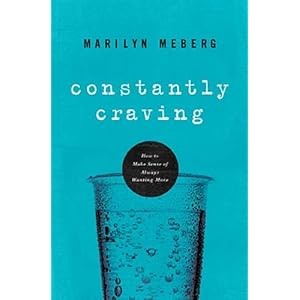
Constantly Craving by Marilyn Meberg
I had high hopes for this book, having used the Amazon search feature to read through a bunch of random interior pages before I selected it from BookSneeze, who provided me with a copy to review. I really thought this was going to be one of my favorite books of the year. but when I actually started reading it, I was pretty disappointed. It’s not that it’s a bad book; I was just hoping for more.

In it, author Marilyn Meberg looks at about a dozen ways that people are often craving “more” from life, whether it’s craving a better romantic relationship, finding more time and respite from busyness, yearning for more meaning in life and a few other of life’s biggies. Of course it should come as no surprise that she reiterates the same thing that Jesus trumpeted here on life, which is that he is the only water that can quench our thirst so that we’re never thirsty again, he is the only Thing that fill us to satisfaction. But she goes deeper and looks at where many of these cravings come from—particularly from our childhood experiences—as well as some very brief insights for how to manage those cravings.

The book is a decent starting place for looking at finding contentment with life, but it seemed rushed and trite and overly simplistic in some parts. I was hoping it would be much more memoir-esque—since the author is in her seventies and has much wisdom to impart! There were many funny snippets from her life sprinkled throughout, but I was eager to see more of a here’s-how-I-walked-this-out aspect that I felt was missing from making this book a truly worthwhile and life-changing read.

You can find  Constantly Craving by Marilyn Meberg on Amazon.

Related Posts
Cultivating Gratitude for the Smallest of Things 
Cultivating A Grateful Heart Even When It Hurts
READ FULL POST >>

Why I Stopped Reading Books....


It’s been awhile since I’ve done much reading outside of the Bible.

Every so often, I have do something like that—put aside all the books that are fresh with copyrights and whose authors are still alive and doing book tours. I have to put them aside so that I can better focus my devotions on that one Book that is as old as time but more important than any other book since.

It’s not that the books I’m apt to read are wrong or bad. They’re not. In fact they’re almost all about that one Book, anyway. But that’s the thing. While they may be about that Book, they are not that Book.

That distinction makes all the difference.

Sometimes it can be incredibly helpful and insightful and necessary to sit down with one of those books, which sheds light on what the Lord has written in his own Book. Those books help us grow closer to that Book and learn to love it like the Author always intended. Many books have done that for me.

But as helpful as those books can be, we must not forget the fact that they are not the Book. At some point, we must go to the Book itself to quench our thirsts and to inform our understandings. We can’t always take someone else’s opinion of it. We have to let the Holy Spirit be our guide, rather than another human being.

The first time I realized this was a couple years after I’d become a Christian. I was devouring these sorts of books, ordering them like candy and chewing on them each night before bed and on my lunch break. They were all Christian living titles, which helped me wrap my head around how I ought to, as a Christian, approach things like dating and politics and the environment and my tendency to stress out over the littlest of things.

They were so helpful in helping shape my understanding of how the Bible and God’s teachings fit into this crazy, chaotic world of ours.

But I realized that I was reading them to the detriment of actually reading the Book that they were all quoting from and point toward. And so, I took my first sabbatical from the books of this world and dedicated myself to reading only the Book. The only Book that can wear a capitalized “B” and you know exactly what I’m talking about. That one.

It was at a similar spot where I found myself a few months ago.

As a writer, I’m also a natural-born bibliophile. It was a love of books that was one of the first things that impressed me about the man whom I later married and who brought his own share of paged volumes into the relationship.

So, I’m easily lured to want to read more, to pick up a new book and learn from what it’s author has gleaned and experienced and written down to share with the world. I trust that there’s plenty to be found in those pages that can help me on this journey to know and love and obey this great Author who has written a story that has captured my heart.

But at some point, those books started to lose interest to me. Even as I stared at my bookshelves and saw so many spines that had yet to be read, they held no sway over me.

There were no more divided attentions. It was only the one Book that I wanted to sit down with and read, to turn to, to sit with. And so, I did.

For months, that’s how it went. And I couldn’t be happier—thrilled, really—to realize that. To know that my truest desire was to sit down with this Book rather than any other book, written by any other hand. I stand in awe, knowing truly how many times I prayed for that kind of heart and desire.

Sure there are still days when I have to make myself sit down with my Bible. There are days I’d rather be working on a craft or lounging on the couch rather than hunkered over this age-old tome. But my heart is understanding how much more I need this Book than any other, and it considers all others second to this One.

I’ve recently dipped my toes back into the reading-other-books-outside-the-Bible waters and made my way through some new books—some of which were worth the time and some of which weren’t. I’ll be sharing some of my thoughts on a couple of those books later this week, but for now, it’s a reminder to me why I choose to keep my focus on that one Book, because it is the one that can never disappoint:

“But if you keep looking steadily into God’s perfect law—the law that sets you free—and if you do what it says and don’t forget what you heard, God will bless you for doing it.” (James 1:25)

Related Posts
What I've Been Doing with Our Extra Books
A Few of My Favorite Things: Bible Study Resources
READ FULL POST >>

The Stories That Speak to Our Souls


While I was reading through my Bible chronologically last year, one of the things I noticed when I made my way into the New Testament was how so many—nearly all, it seemed—of Jesus’ parables revolved around explaining what the Kingdom of Heaven is like.

“The Kingdom of Heaven is like…,” he starts off, going on to compare it to some field workers, a group of bridesmaids, treasure hidden in a field, a king throwing a party, servants entrusted with silver, seed planted in a field, yeast for making bread, a pearl of great value, a net that catches fish of all sorts.

I knew Jesus was always telling parables, using them as a way to speak to his listeners’ truest hearts as they seek to unlock the mysteries hidden within his words. As he said to them, “Anyone who is willing to hear should listen and understand!” (Matthew 13:9)

The thing that I didn’t really notice, until now, was just how much they all had to do with describing, explaining, and warning about what the Kingdom of Heaven is like. There are a few other parables that have to do with other stories, but nearly all are about this Kingdom to come.

And it made me wonder… Why?

Why did he keep hammering this point home? Why did he keep telling the people in dozens of ways how this Kingdom will take them by surprise, that they must be prepared for this Kingdom, that they must seek it out at all costs and treasure it, that they must be willing to give up everything for this Kingdom?

Oftentimes with these parables, he’s speaking directly to Jews, people who knew the Torah well and had been raised in a culture that was waiting expectantly for the Messiah.

Yet, they were the very ones who were blind to the fact that He was actually among them. Though they were looking, they could not really see Him when He was right before their eyes.

They misunderstood what the mission of the Messiah was really all about and were led astray to the point of killing the very one who came to set them free.

And that was what he preached against, time and again. Hammering away against these misunderstandings, stripping away the ill-gotten perceptions, helping them see the truth, the way, the life of this Kingdom.

As we read these words--centuries later after the Messiah has come and gone and again we await his return—perhaps they are as much for us as they were for those first-person witnesses: Stories to keep us from being led astray. Stories to remind us what this Kingdom we’re awaiting is really all about. Stories that prepare us for the day when that Kingdom is at hand.

As Jesus preached again and again to the crowds that flocked to him, so we ought to keep preaching to ourselves. Because it can be so easy to miss the point, to get distracted and confused and off track. It can be so easy to get it wrong and miss it entirely.

And that’s the thing about the Kingdom of Heaven; it’s so important, so meaningful, so everything that to miss out on it is a grievous thing. That’s why Jesus spent so much time talking about it, in hopes that one of the ways he would say it would open our ears and fill our hearts with such love that that Kingdom would overwhelm our lives.

To those first disciples, Jesus explained, “You have been permitted to understand the secrets of the Kingdom of Heaven, but others have not. To those who are open to my teaching, more understanding will be given, and they will have an abundance of knowledge.

“But to those who are not listening, that is why I tell these stories, because people see what I do, but they don’t really see. They hear what I say, but they don’t really hear, and they don’t understand.

“…But blessed are your eyes, because they see; and your ears, because they hear.” 
(Matthew 13:11-13, 16)

Blessed, indeed.

Related Posts
Lessons from Nehemiah: More Than a Man Who Rebuilt a Wall
Taking a Judaism Class 
READ FULL POST >>

Getting Rid of the Mice, One Trap & One Prayer at a Time


Remember the mouse that I saw scurry through our living room? And how we were faced with the dilemma of dealing with the little critter? (Catch up on that story here if you need to.)

Well, this is the story of how we did that. One trap, one prayer at a time.

As I mentioned, the first thing we went about doing was shoring up the holes where we thought the mouse was getting in through. The closer we looked, the more we located more and more possibilities for the tiny creature. So we started the process of filling them in, closing them up in hopes that no more friends would join in the party.

But then we had to deal with the mouse (or mice) that were already here. After discussing our options, we decided we wanted to buy traps rather than poison because we wanted to know if we’d got the mice and keep them from dying somewhere in our house.

We placed them strategically, with a dab of cashew butter as bait. After the first night, we went and checked them. The mouse had managed to nibble the butter off without setting off the trap. This guy was craftier than we’d expected!

So we re-set the trap and put the bait further along the back, so that they had to climb in further. We caught one that night. I was so thrilled but wondered if there might be more? My fears were concluded the following evening when I was putting away groceries and as I placed a bottle of olive oil in a cupboard, a mouse jumped out and ran behind the stove.

Of course, I screamed bloody murder and my husband came running, thinking I’d cut myself on a knife or something. Oh, no. Just a flying, daredevil mouse, that’s all.

So we reset the traps again, realizing that this was not a one-mouse ordeal as we’d first hoped. Over the course of five nights, we caught five mice.

The entire time, I kept praying that there would be no more. That the Lord would keep them away so that we didn’t have to keep catching and killing them. And yet, then we’d catch another.

Finally, on Saturday night of that week, after catching the fifth mouse, I was desperate. I stood in our kitchen and was reminded of the place in Matthew where Jesus says, “I tell you the truth, if you have faith as small as a mustard seed, you can say to this mountain, 'Move from here to there' and it will move. Nothing will be impossible for you.”

These mice were much smaller than any mountain. If my faith could move a mountain, surely it could move a handful of mice. And so I took that command to heart and, out loud, told the mice to leave this house, in the name of Jesus Christ.

The next morning, my husband and I went to church. One of the things that I fell in love with when we first started checking out this church was that they take prayer requests during the service and pass around prayer-request binders that the leaders pray over and that get emailed out to all the members. Prayer is not something underestimated, here.

In the binder, my husband wrote down our paltry prayer request: That there would be no more mice in our house. It was not asking for healing or salvation or any other prayer request that deserves to be answered. But yet, our prayers need not be big for the Lord to care about them and take them seriously. The only requirement of our prayers? That we ask.

So we did.

And you should not be surprised to find out that we have not caught a single mouse since. Not a single one. No sightings of any other ones, either. The cashew butter is fresh on the traps, waiting just in case. And it’s been that way ever since.

Because even though God cares about all the big things in our lives, he also cares about the littlest. Like a tiny, brown mouse who popped in for a visit.

Related Posts
My True Story of Being Healed by Prayer 
Are Your Prayers Big Enough? The Why's & How's of Praying Big
READ FULL POST >>

Why We Can’t Give Up…


You know the saying, "Can’t see the forest for the trees."

I recently realized I think that it’s all too often that we do that with our reading of the Scriptures.

The last book that I read in my chronological Bible reading plan last year was Revelation. It’s a book that is hard to wrap your head around, to understand all the plagues and bowls and lampstands and locusts. It’s a book where we can get hung up on these mysteries and symbolisms and wonderland-like images and miss the bigger point that is going on in the story.

I’ve always thought Revelation was about the Antichrist and Armageddon and the end of the world as we know it. And it is.

But as I read through it this last time, I realized it’s about much more than that.

In the beginning of the book, John delivers messages to seven churches in Asia, from Ephesus to Laodicea. In these messages, he urges them to love and obey God passionately, to press on despite persecution, to pursue peace and serve one another selflessly, to stay away from evil and to keep the faith.

After these letters, he launches into his great revelation that talks about what lies ahead for the earth and everyone in it, how Christ will come again and redeem it from all evil and usher in the kingdom of heaven and all the perfection that comes with it. It’s in this portion that we read about all the supernatural episodes of dragons and beasts and bottomless pits, of wedding feasts and white robes of linen.

For the most part, I’ve always thought of Revelation as being divided into two; the letters being separate from John’s revelation.

I was listening to a Misty Edwards song (which you can download for free here) where she sings, “Don’t give up. Don’t give in. If you don’t quit, you'll win. You’ll win! 'Cause everything is in my hands. It’s going to be alright, going to be okay. Just don’t give up…”

As I listened to those words, I realized that I think that’s the same message that John was trying to tell his readers. In his letters, he told them not to give up, to keep trusting the Lord. But he takes that one step further through the revelation, where he reminds them why they need to keep holding on: Because everything is going to be okay.

Through the revelation, he tells them that Christ is going to come back and redeem everything. God has not forgotten about the suffering of his people. He holds it all in his hands and is going to make it right. He is going to rescue his people and they will finally get to enjoy the peace and the perfection that he has promised them from the beginning.

Scholars can argue back and forth about the meaning of the numbers and the images and the years that are described through the pages of this book. They can argue whether it’s all literal or poetic or something in between. They can get hung up on the details and miss the bigger point that is going on here.

We must not give up. This world is going to be trying and there are going to be days that are difficult. But we must keep holding on to our faith because if we do, we’ll see that God is going to turn it all around in the end. We must cling to that promise and trust that we will get to see the fruits of his victory when the time comes.

Until then, we must not give up.

Related Posts
Lessons from Reading Through the Prophets
A Morning Prayer to Start Today
READ FULL POST >>
Previous Post
Related Posts Plugin for WordPress, Blogger...